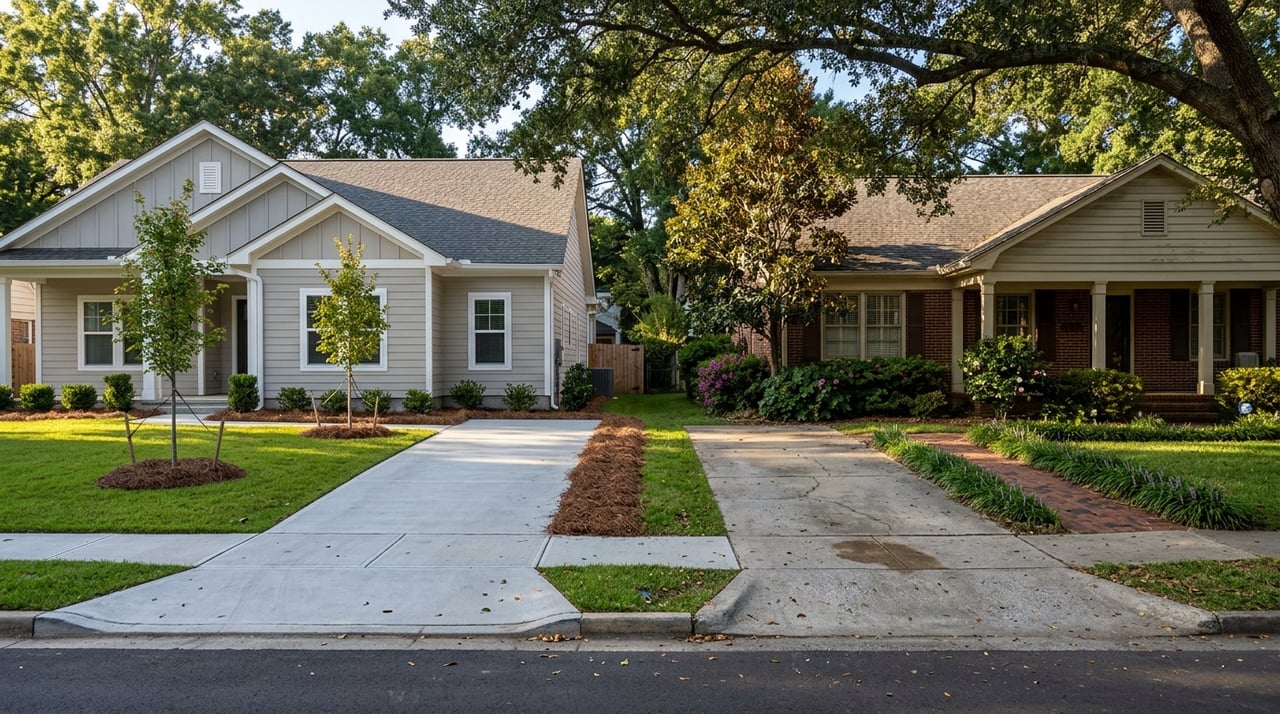
Covington Neighborhoods Comparison: Newer vs. Established
July 2, 2026
July 2, 2026
Wondering whether a newer community or an established neighborhood is the better fit in Covington? It is a smart question, because in 70433 the choice often affects more than the age of the home. It can shape your daily routine, renovation options, lot use, and even how the street feels when you pull in after work. This guide will help you compare the tradeoffs clearly so you can focus on the neighborhood that fits your goals best. Let’s dive in.
Covington is not one uniform housing market. The city’s planning and zoning framework includes historic districts, standard single-family areas, and planned overlays such as Covington Commons, Barkley Parc, The Groves, Square 1907, and Reagan Crossing.
That means choosing between newer and established neighborhoods is also a choice between different street patterns, design expectations, and property rules. Covington’s Plan 2030 vision also emphasizes walkability, bikeability, historic integrity, access to amenities, and hazard resilience, all of which can influence how a neighborhood feels over time.
Established neighborhoods in Covington often stand out for character and a more varied streetscape. The city’s historic guidelines point to details like street-facing façades, traditional setbacks, ornamental features, and parking patterns that help create a stronger sense of architectural identity.
Some older areas may also feel more rooted and visually distinct from block to block. If you value mature surroundings, a less uniform layout, and a home with a more established presence, these neighborhoods may be worth a closer look.
Covington has two local historic districts: the Covington Historic District and the North Covington Historic District. If a property is inside one of these districts, exterior changes may require review by the Historic District Commission and a Certificate of Appropriateness.
That review can apply to construction, alterations, demolition, or relocation. The guidelines focus on preserving features such as setbacks, street orientation, traditional fences, and architectural details, but they do not regulate interior changes or paint color.
If you are thinking ahead to an addition, detached garage, fence, or carport, established neighborhoods may require more due diligence. The home’s charm may come with rules that affect what you can change later.
That does not make older neighborhoods harder by default. It simply means you should confirm what is allowed before you count on future updates.
Newer planned communities in Covington often have more coordinated layouts and more predictable lot patterns. The city’s zoning map shows several planned overlays, which suggests a more organized development pattern than you may find in older platted areas.
For many buyers, that can translate into a cleaner, more consistent neighborhood layout. You may also find a more standardized street experience from one section to the next.
Newer homes are generally more likely to reflect current building and energy code requirements. The city notes that Louisiana is using the 2021 I-Codes and 2021 energy code requirements, and permit applications require details such as setbacks, flood zone information, and drainage features.
That does not automatically make one home better than another. It does mean a newer home may offer fewer immediate update questions compared with an older property, especially if low-maintenance living is high on your list.
Some buyers prefer a neighborhood where lot placement, setbacks, and overall layout feel more uniform. That kind of predictability can make it easier to compare homes and visualize how the area may develop over time.
In newer communities, it is still important to check subdivision-specific rules, future phases, and nearby land that may still be planned for development. A neighborhood that feels complete today may still be evolving.
In Covington, lot size is not the same from one area to the next. The city’s zoning map includes both Existing Small Lots and Existing Large Lots districts, which shows that the relationship between house and yard can vary quite a bit across the city.
That is why the real question is not just how large the lot looks on paper. You also need to understand how much of that lot is actually usable after setbacks, drainage features, easements, and driveway placement are considered.
When you tour a home, try to look past the listing photos and ask practical questions. A generous lot can feel much smaller if the most functional space is limited by drainage patterns or placement restrictions.
As you compare homes, pay attention to:
Covington’s planning documents show a local focus on neighborhood preservation, housing choice, affordability, pedestrian safety, and access to parks and waterways. That makes lifestyle a major part of the decision, not just square footage or year built.
Established areas may offer older street patterns and a stronger sense of place. Newer planned communities may offer easier internal circulation and a more orderly layout.
The best neighborhood for you should support your routine. Consider how the home feels from the street, how you move through the neighborhood, and how easy it is to get to errands, recreation, or other regular destinations.
A home can check every box on paper and still feel less convenient in everyday life. That is why a showing should include both the property and the broader street experience.
In Covington, flood and drainage questions belong in every home search, whether the neighborhood is new or established. The city participates in the National Flood Insurance Program and notes that standard homeowners insurance typically does not cover flood damage.
The city also explains that local drainage depends on a mix of natural drainageways, channels, storm sewers, ditches, and detention or retention basins. In other words, flood risk is not just about neighborhood age. It is specific to the property and how water moves across and around it.
The city’s permit application states that projects in Flood Zone A or B require an elevation certificate and must document drainage features. That makes it especially important to ask questions early.
Useful questions include:
In St. Tammany Parish, school assignment is address-based. The district’s School Finder allows buyers to search by property address, and the Covington Attendance Office can help with boundary questions.
That means it is best to verify school eligibility after you narrow your shortlist. A subdivision name alone is not enough to confirm school assignment.
If you are stuck between a newer home and an older one, focus on the tradeoffs that will matter long after closing. In Covington, the biggest differences often come down to character, flexibility, lot feel, drainage, and neighborhood rules.
Here is a simple way to think about it:
| Priority | Newer Neighborhoods | Established Neighborhoods |
|---|---|---|
| Street layout | More coordinated and predictable | More varied and organic |
| Home style | Often more standardized | Often more distinct architecturally |
| Renovation freedom | May depend on HOA or subdivision rules | May be affected by historic district review |
| Code standards | More likely to reflect newer codes | May require more system updates over time |
| Lot feel | Can be more uniform | Can vary more from property to property |
A strong showing is about more than liking the kitchen. You want answers that help you compare what will be hardest to change later.
For many Covington buyers, this decision is really about tradeoffs. If you care most about architectural character, established surroundings, and a more varied streetscape, an older neighborhood may feel right. If you want a more predictable layout and a home that is likely closer to current code standards, a newer community may be the better fit.
The key is to compare homes through the lens of how you actually live. When you look closely at lot use, future flexibility, drainage, and address-specific details, your best option usually becomes much clearer.
If you want help narrowing down the right fit in Covington, Felicity Kahn & Associates offers local, hands-on guidance to help you compare neighborhoods with confidence.
Stay up to date on the latest real estate trends.
Collaborate with a team that values professionalism, growth, and a refined approach to real estate success.